Medica/CompaMed
Spotlight: Medica’s Health IT Forum
From sustainable AI to the "Hospital of the Future," the forum addresses the promise and challenges of healthcare IT.
By: Michael Barbella
Managing Editor
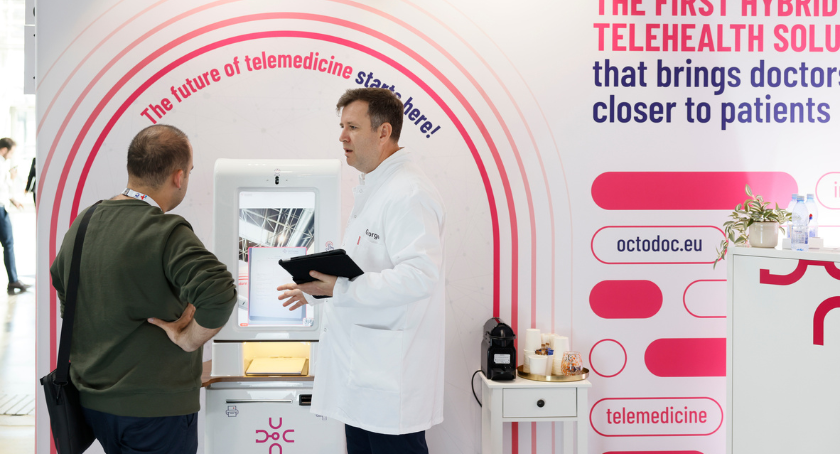
A focus of Medica is digital health/medical IT. Photo: Messe Düsseldorf/Constanze Tillman.
Are there specific ways that innovation can help master the challenges and demands confronting healthcare across international borders? This question is a central theme this week at Medica’s Health IT Forum, an entrenched part of programming at the world’s largest medical trade fair in Düsseldorf, Germany.
Sessions and talks are focusing on such issues as artificial intelligence, robotics, and virtual care. The first session on Nov. 11 addressed the technological, ecological, social, and ethical aspects of “sustainable AI.” Ideally, AI systems should be powerful, responsible, and environmentally friendly; however, there is still much work to be done. Speaker Prof. Peter Boor, with University Hospital RWTH Aachen, recently tackled this issue in a publication about the widespread use of deep learning within pathology. While such extensive use of the technology could contribute to the Earth’s warming climate, Boor and other authors claim that with a few measures, digital pathology quality can be maintained and help reduce carbon emissions.
Smart Phones for Therapy
Digital solutions and their use for therapeutic purposes was the focus of a discussion on Nov. 11 (“Health Companions 2.0”). Dr. Cinthia Briseño, founder and managing director at Frisk, met Rouwen Hirt, business development manager for the app solution “Constanze Care.” In the app, an integrated female AI assistant and a team of female experts work together to provide the best answers to questions posed by pregnant users. The app provides information on the prenatal examinations necessry during pregnancy, the ways women can prepare for post-partum, and the remedies for babies with a stomach ache. The AI bases its knowledge from current scientific results, new medical guidelines, and expert experience.
Concerning medicines, Redcare Pharmacy’s “Shop Apotheke” is among the most well-known German online pharmacies. With its “eHealth-CardLink” solution, Redcare Pharmacy offers users an option to submit electronic prescriptions. With the help of an electronic health insurance card and a smart phone, customers can pass electronic prescriptions to the Shop-Apotheke app.
Examining the EU’s AI Act
Generative AI is the main focus of a Nov. 12 panel discussion moderated by Dr. Julia Hoxha, head of the Health work group at the German AI Association. She is also the co-founder and managing director of Zana, a startup that uses human speech as biomarkers.
Panel members discussed their views on the European Union member states’ world-first “AI Act” to regulate artificial intelligence. “This law has far-reaching consequences for everyone involved, including hospitals and other users. If things go badly, the costs for these applications will increase,” Hoxha said. Such high expenses, however, could be mitigated by good planning and intelligent design. For example, manufacturers should ensure to prevent their AI system from falling into an unnecessarily high risk category. AI solutions providers should also expect the “AI Act” to allow exceptions and mitigations for small companies and for science. The ability of AI to generate novel molecular structures and predict their properties is an important application for the technology within healthcare, Hoxha claims.
The company Merantix Momentum uses AI to optimize active agents in large molecules. AlphaFold by Google DeepMind makes it possible to predict the proteins’ 3D structure. Dr. Bertram Weiss, pharma lead at Merantix Momentum, and Dr. Augusta Modestino, head of Strategy at AICURA Medical, are participating in the Health IT Forum’s AI panel. Dr. Nilofar Badra-Azar explained the use of data in this context from a political point of view. She is a consultant at the German Federal Ministry of Health in the Division Key Policy Issues Concerning Novel Technologies and Data Use. During the discussion, Badra-Azar discussed ways the AI Act governs the use of health related-data and both regulates and strengthens medical registries.
Smart Robotics
Robotics is perhaps one of the most dominant technologies with healthcare’s digitalization, and this evolving innovation is the central theme for a Tech Talk on Nov. 12. Dr. Manuel Ferla, TU Munich, School of Engineering and Design, is convinced that robot-assisted surgery provides doctors with valuable tools, which reduce the stress during surgery and could lead to improved patient outcomes. However, this relatively new technology is still limited in use due to the lack of integration into existing clinical procedures. Novel methods and technologies aim to improve system integration to realize an improved perspective for applications.
Lukas Bernhard, scientific head at the TUM University Hospital Klinikum rechts der Isar in Munich, has been part of the research group MITI and has worked on a robot that performs various tasks during surgery. The robot fetches sterile materials—sutures or gloves, for example—from storage, delivers them to the operation theatre, opens the packaging, and passes the sterile goods to the operating surgeon. In a current publication, Bernhard reports that such systems can potentially become invaluable tools for overcoming a lack of trained staff and to rationalize menial work processes within healthcare. However, these robots must overcome the challenges resulting from the strict regulatory requirements.
Digital Clinical Networking
Hospitals are currently facing considerable changes, triggered by the increasing concentration of medical treatments at specialized sites—an aftereffect of Germany’s hospital reform. Medica participants can catch a glimpse of their profession’s clinical outlook with the special exhibition “Hospital of the Future,” in Medica Hall 13 (booth C04). Here, decision makers from clinics can receive input and consultations on:
- Digital infrastructure in a hospital: finding trustworthy solutions for telecooperation
- Intelligent summaries of and processed patient data in stead of manual documentation: efficient use of medical resources
- Data-driven telemedicine and artificial intelligence in intensive care medicine: Care for patients in a personalised and predictive manner
- Far away yet with a close view of the patient: carrying out databased teleconsultations.
“Hospital of the Future” is organized by the German telemedical society “Deutsche Gesellschaft für Telemedizin e.V.” in cooperation with Messe Düsseldorf. Expert support on planning and implementation is provided by the German centre for telematics and telemedicine Zentrum für Telematik und Telemedizin GmbH (ZTG) and the Clinic for Surgical Intensive Medicine and Intermediate Care at the University Hospital RWTH Aachen. Medica visitors and delegates of the 47th German Hospital Conference can enjoy exclusive guided tours through the special exhibition.