Medica/CompaMed
Past World Cup Winner Prevails Again at VIVE XR Healthcare Challenge
machineMD takes top prize with its VR and AI-enhanced brain disorder diagnostic tool.
By: Michael Barbella
Managing Editor
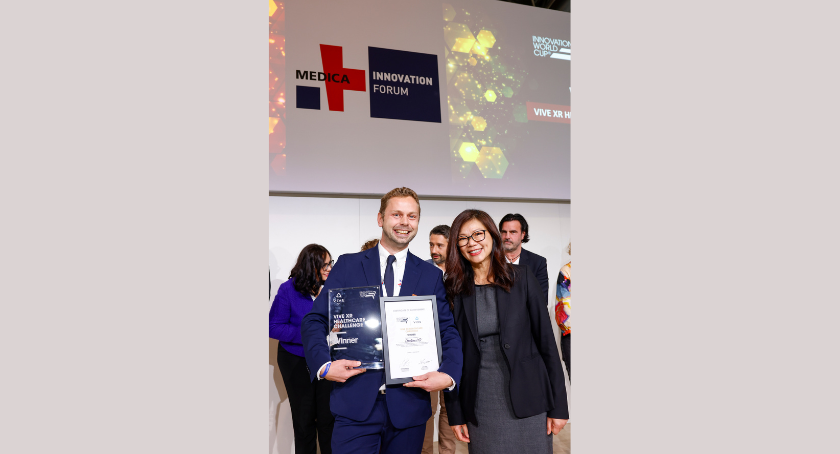
Phil Norris, chief commercial officer at machineMD, accepts the company's first place award at the VIVE XR Healthcare Challenge, held during Medica 2024. Photo: Messe Düsseldorf/Constanze Tillman.
Talk about déjà vu.
Phil Norris found himself in familiar territory earlier this week—on stage in front of a small audience, accepting a top honor on behalf of his employer.
The company at which Norris serves as chief commercial officer captured first place at the VIVE XR Healthcare Challenge, a special prize of the Healthcare Innovation World Cup powered by HTC VIVE, a global provider of extended reality solutions. The Challenge was held during Medica 2024, the world’s largest medical trade show, in Düsseldorf, Germany.
Swiss-based machineMD triumphed over its two opponents at the Challenge, winning market access as well as resources, mentorship, and networking opportunities through HTC VIVE’s ecosystem. A 10-member jury comprised of senior executives from HTC VIVE, Siemens Healthineers, STMicroelectronics, EBV Elektronik, Wurth Elektronik, and Female Founders (among others) chose the victor based on innovation level, technology, market approach, and sustainability impact. Each finalist had five minutes to pitch their business case to the jury.
“This award recognizes the significant progress that machineMD has made by alreading bringing a VR-based medical device to market,” Norris said. “Our strong innovation pipeline is set to empower primary and secondary care providers with better diagnostic tools for brain health.”
Innovating at the intersection of neuroscience and ophthalmology, machineMD combines virtual reality (VR) and artificial intelligence (AI) to help diagnose and monitor brain disorders. That technological mashup was a jury favorite last year too, winning the top prize in the 15th Healthcare WT Innovation World Cup in April 2023.
machineMD’s Class IIa medical device, neos, is a reusable system available in the United States that performs an automated examination of eye movements and pupillary function, the latter including visual field screening. Delivered through a VR headset, neos systematically presents visual stimuli to both eyes individually and together, measuring the resulting eye movements and pupillary changes in each eye and charting the data. neo can perform eight exams in under 12 minutes, or shorter testing sequences from three minutes.
neos uses infrared eye tracking at 200HZ, mounted in a headset with numerous refractive error correction lenses. All data is processed securely in the cloud.
“Congratulations to machineMD for winning the VIVE XR Healthcare Challenge, part of the Healthcare Innovation World Cup,” stated Thomas Dexmier, sales/marketing head, EMEA, at HTC VIVE. “There was incredible innovation from all three finalists…all three demonstrated how patient outcomes can be improved, and it’s clear that immersive technology can make a huge difference in healthcare.”
Indeed it can, as evidenced by machineMD’s challengers:
- ORamaVR: This Swiss-based company launched its medical extended reality (XR) training suite over the summer, offering educators and students a complete software solution for creating, publishing, and experiencing computational medical XR simulations. Its MAGES SDK is a medical virtual reality-first software development kit that allows for rapid prototyping of any shared, collaborative networked medical operation in VR; the solution draws its novelty from 20 years of academic R&D.
- VRAIn: A Spanish firm that develops 3D bioimaging software solutions for the medtech and biotechnology sectors, focusing on digital health and medical devices. Its core product is a cloud-based immersive platform for visualizing and analyzing any biomedical images (magnetic resonance imaging, computed tomography scan, ultrasound, microscopy, etc.) from patients in spatial computing environments, integrating VR, augmented reality, and AI. These collaborative environments increase generated data 100-fold and accelerate its analysis up to 1,000-fold compared with current 2D systems. Such boosts in data generation and speed help reduce diagnostic errors, improve medical training, and provide patient care safety, reliability, and engagement, according to the company.