Medica/CompaMed
Heat-Shrink Tubing from Cobalt Polymers—5 Questions at Medica/CompaMed
Barry Schnur explains how the company’s new offerings and Applications Lab better address customers’ needs for heat-shrink tubing.

By: Sean Fenske
Editor-in-Chief
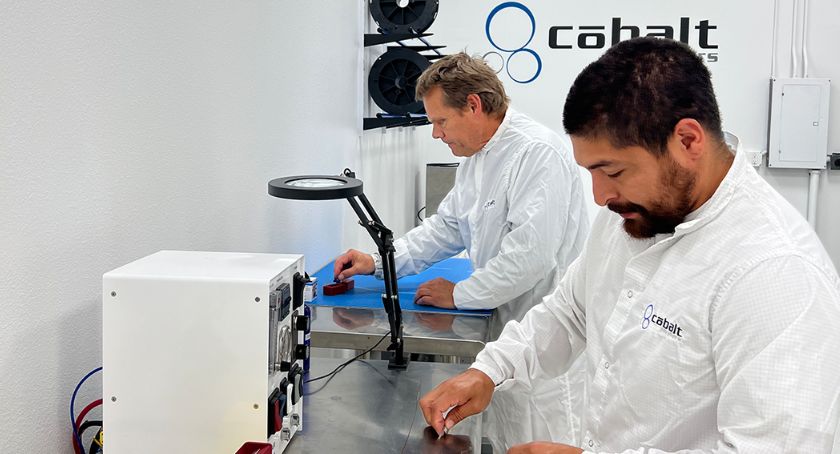
Cobalt Polymers’ new Applications Lab provides dedicated space to help customers choose the right tubing size, durometer, and wall thickness and develop and troubleshoot the process of applying Pebax and Polyolefin Heat Shrink Tubing.
When the smell of bratwurst fills the air and the cool wind has just a bit of moisture in it, you may be traveling between the enormous halls at the Messe Dusseldorf Center in Germany. Anyone who has visited this event in the past knows the sheer volume of attendees and exhibitors, making it difficult to find a company that may be able to aid with an upcoming design or development project.
With this in mind, MPO presents its annual series of Q&A sessions with a number of supply chain companies exhibiting at the show. Perhaps Cobalt Polymers will have the answers for your current development idea and help you get to the finish line faster. We spoke with Barry Schnur, interim CEO, at the company to get some additional insights on what Cobalt Polymers does and how it may be able to serve you.
Sean Fenske: What technology or service are you emphasizing at Medica/CompaMed this year?
Barry Schnur: We’re highlighting our newest heat shrink tubing products. In response to customer requests, our smallest-diameter 72D 2:1 ratio Pebax Heat Shrink Tubing is now available in three thin-wall thicknesses: 0.051 mm, 0.076 mm, and 0.127 mm. This thin-wall tubing is great for covering substrates as small as 0.2 mm, including small wires, optical cables, and sensors for applications such as electrophysiology.
On the other end of the spectrum, our new larger-diameter 4:1 ratio Pebax Heat Shrink Tubing is ideal for catheter-based devices for larger applications like structural heart, with flexibility, super-thin walls (0.025 mm to 0.076 mm), and diameters up to 9 mm expanded.
We’re also talking about our new Applications Lab, which provides dedicated space for our technical team to help customers choose the right tubing size, durometer, and wall thickness and develop and troubleshoot the process of applying Pebax and Polyolefin Heat Shrink Tubing.
Fenske: What’s the most common challenge customers inquire about and how do you address it?
Schnur: Applying heat shrink tubing requires a “recipe” with the right time, temperature, and heat source. That’s why we created our new Applications Lab—to help customers choose the right tubing specifications and application process for their devices. We’ve found that customers who collaborate with our technical experts discover innovative options they wouldn’t have considered, solve problems more quickly, and reduce engineering time.
Fenske: If you could give one piece of advice to companies seeking a manufacturing partner before they make a decision, what would it be?
Schnur: I’d say the top three are deep expertise in manufacturing that particular component, adequate capacity and lead time, and a long track record of success and customer support. At Cobalt, we still serve some of our original customers from when we started more than 20 years ago, and we support some products that have been in production for 15 years over multiple generations.
Fenske: What are the forces driving medical device manufacturers to seek your technology/services over doing it in-house?
Schnur: Heat shrink tubing is a complex component to manufacture, with a heavy capital equipment investment and a proprietary fabrication process. It wouldn’t make sense for most companies to produce it in-house. Cobalt fulfills the needs of heat shrink tubing customers so they can focus on their core competency—medical device products.
Fenske: In what ways is your company able to aid in getting a product (project) to market faster?
Schnur: First, we can help speed the prototyping process with a wide range of in-stock tubing at Chamfr.com and free samples that ship quickly. Second, we offer local support to help customers choose the right tubing and application process, with technical sales engineers in Europe, the Middle East, Asia, and North and Central America. And third, our facility has plenty of capacity to handle production orders with short lead times.
Cobalt Polymers is located at Medica/CompaMed in Hall 8B, Booth/Stand F20-6.